


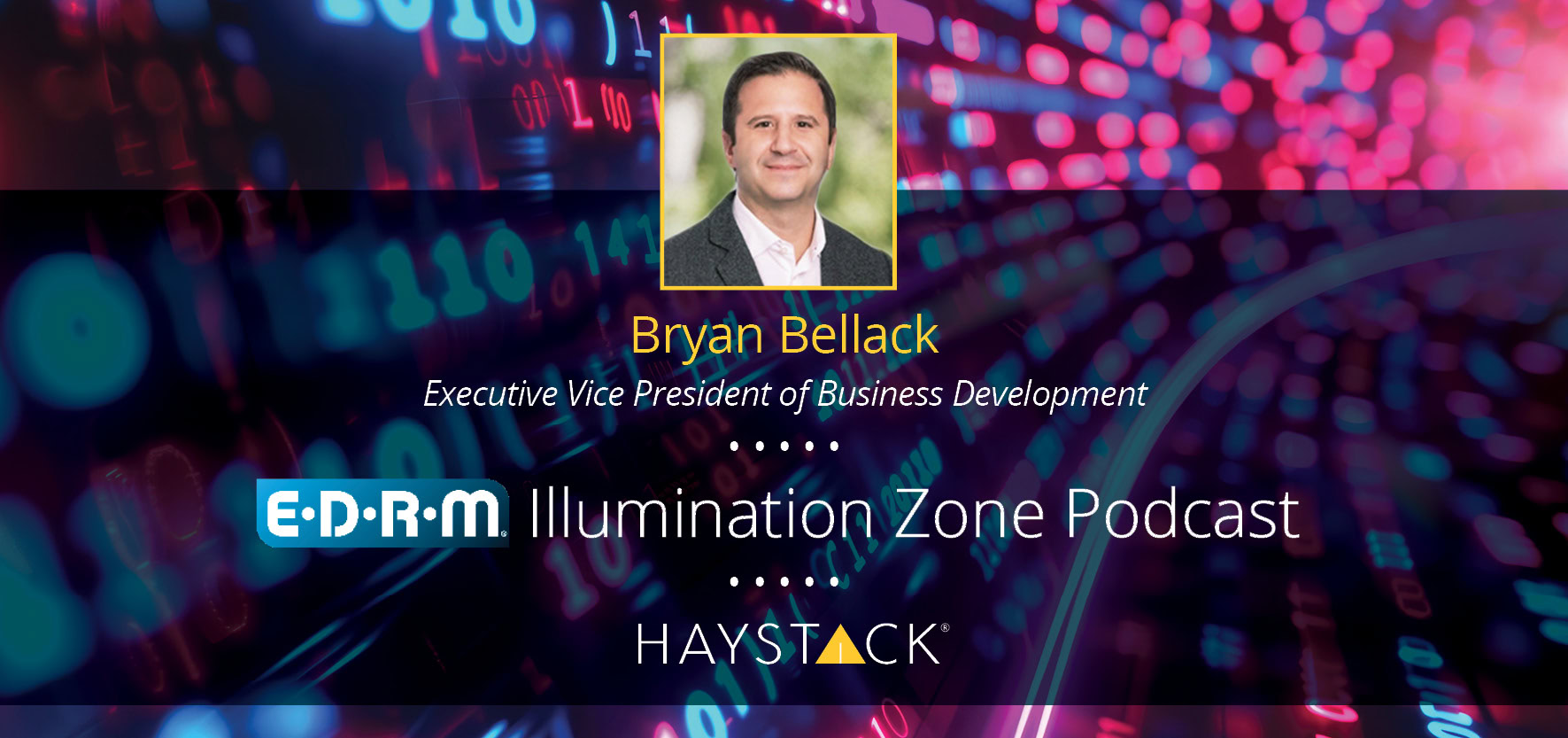
[Podcast] HaystackID® in the EDRM Illumination Zone: Bryan Bellack, Executive Vice President
Editor’s Note: This episode of the EDRM Illumination Zone highlights the operational realities of white-collar investigations—from establishing privilege in the first phone call to coordinating multinational collections under privacy constraints. HaystackID Executive Vice President Bryan Bellack shares observations on the mainstreaming of generative AI in discovery, the importance of experienced legal leadership, and the expanding toolkit for rapid triage, mobile data capture, and early insight generation. The discussion also addresses responsible AI controls, emphasizing guardrails, output verification, and preparation for emerging agentic workflows. These insights are timely for in-house counsel, outside counsel, investigators, and review leaders seeking faster, defensible pathways from allegation to action.
[Podcast] HaystackID® in the EDRM Illumination Zone: Bryan Bellack, Executive Vice President
By HaystackID Staff
Hosted by EDRM’s Mary Mack and Mary Bennett, with EDRM’s Holley Robinson, this Illumination Zone episode features HaystackID Executive Vice President Bryan Bellack discussing what has changed in investigations and discovery over the past 18–24 months and what now works in practice. He noted the rapid, mainstream adoption of AI on high-value matters—class actions, MDLs, and investigations—where legal teams now regularly ask how GenAI may accelerate early understanding, reduce data volumes, and focus scarce expert time on signals rather than noise.
Bridging into incident response, Bellack emphasized immediate steps when an organization faces potential white-collar exposure. The first action is to engage counsel to establish privilege and appoint a clear quarterback for decisions and communications. With counsel directing the work, teams can avoid common missteps such as self-collection that risks spoliation, ad-hoc exports that leave audit gaps, and cross-border actions that conflict with local privacy laws or cultural practices.
From there, the conversation turned to why white-collar matters feel like “eDiscovery on steroids.” The stakes are higher, timeframes shorter, oversight more intense, and data sets more complex and international. Forensics specialists must operate across jurisdictions, manage permissions and paperwork for privacy compliance, and handle diverse data sources—including mobile and social platforms—without disrupting business operations. Bellack described how experienced teams combine seasoned forensics talent, disciplined process, and tuned technology to meet deadlines measured in hours and days, not weeks.
The technology segment provided a practical view of what teams deploy today. Beyond market offerings such as Relativity aiR and eDiscovery AI, HaystackID’s Case Insight and Case Elements are used to cull rapidly, elevate key people, events, and timelines, and generate dashboards that guide early case strategy. Remote capabilities for mobile and social data collections reduce latency and allow data to stream quickly into review environments. Even with these accelerants, Bellack stressed conservative, quality-controlled workflows and legal supervision to ensure defensibility.
The episode also examined responsible AI. Bellack discussed work advising on AI control and risk management—implementing guardrails around inputs and outputs, aligning with information governance goals, and enabling confidence through rapid output checking. He noted that better safety and verifiability can unlock broader professional use by attorneys and other experts. Looking ahead, he anticipates Agentic AI that coordinates tasks across systems, making governance, brand consistency, and monitoring even more important.
As a final bridge to practitioner priorities, Bellack underscored the importance of communication with boards and executive stakeholders throughout an investigation. Clear objectives, frequent updates, and disciplined issue tracking help sustain momentum while legal teams manage multi-jurisdictional requirements and parallel workstreams.
Key Takeaways for Investigators and Legal Teams
- Call counsel first. Establish privilege immediately and appoint an investigations quarterback to direct next steps and communications.
- Avoid self-collection. Prevent spoliation and audit gaps; route actions through forensics professionals with privacy documentation in place.
- Plan for cross-border nuance. Account for local privacy law, culture, and on-the-ground access realities before scheduling collections.
- Use AI for early insights, not shortcuts. Employ GenAI to triage, surface timelines, and identify custodians while maintaining rigorous QC and legal oversight.
- Accelerate mobile and social collection. Leverage remote collection capabilities and rapid streaming into review to compress early-case timelines.
- Implement AI guardrails. Control inputs/outputs, enable verification, and align with information governance to expand safe professional use.
- Communicate in real time. Maintain frequent, structured updates for boards and executives to keep decisions aligned and cases moving.
More About Bryan Bellack
Bryan Bellack is Executive Vice President at HaystackID. His background includes leadership roles as a managing director at a consulting organization and vice president at Epiq, and early work in the New York City Law Department’s World Trade Center unit. He holds a BA in political science and international affairs and a JD from the Maurice A. Deane School of Law at Hofstra University. He also advises on safe and responsible AI through work with an AI control and risk management platform.
The podcast is available on your favorite listening app, including Spotify, Apple Podcasts, and Google Play. The podcast is also available on the EDRM website and is provided below for convenience.
Join HaystackID’s experts as they share actionable insights on today’s most material topics—from how GenAI is reshaping legal data strategies to the latest approaches in digital forensics. Explore our full library of EDRM Illumination Zone podcast episodes.
About the Electronic Discovery Reference Model
Empowering the global leaders of e-discovery, the Electronic Discovery Reference Model (EDRM) creates practical global resources to improve e-discovery, privacy, security, and information governance. Since 2005, EDRM has delivered leadership, standards, tools, guides, and test datasets to strengthen best practices throughout the world. EDRM has an international presence in 136 countries, spanning six continents. EDRM provides an innovative support infrastructure for individuals, law firms, corporations, and government organizations seeking to improve the practice and provision of data and legal discovery with 19 active projects. Learn more at EDRM.net.
About HaystackID®
HaystackID® solves complex data challenges related to legal, compliance, regulatory, and cyber requirements. Core offerings include Global Advisory, Cybersecurity, Core Intelligence AI™, and ReviewRight® Global Managed Review, supported by its unified CoreFlex™ service interface. Recognized globally by industry leaders, including Chambers, Gartner, IDC, and Legaltech News, HaystackID helps corporations and legal practices manage data gravity, where information demands action, and workflow gravity, where critical requirements demand coordinated expertise, delivering innovative solutions with a continual focus on security, privacy, and integrity. Learn more at HaystackID.com.
Assisted by GAI and LLM technologies.
Source: HaystackID